Design & Installation
New height safety system design and construction for commercial and industrial buildings, certified to AS/NZS 1891 on completion.
Overview
Every new commercial building requires a height safety system that enables safe access to the roof for maintenance, cleaning, plant servicing, and inspection. Many existing buildings also lack adequate height safety -- either because they pre-date current standards, because the original system was minimal, or because building modifications (solar panels, new plant, facade changes) have created access requirements not anticipated in the original design.
Allied Commercial designs and installs complete height safety systems from first principles. Our engineers survey the roof, understand who needs access (cleaning contractors, HVAC technicians, solar maintenance crews, facade inspectors), determine the access routes and work zones required, and design a system that provides continuous fall protection for every anticipated task.
System components include single-point anchors (roof-mounted, parapet-mounted, or structural), horizontal static lines (cable-based, rail-based, or track-based), vertical lifeline systems for ladder access, guardrail systems for roof perimeters and plant areas, walkway systems for fragile roof surfaces, and access hatches with integrated safety posts. Every component is sourced from certified manufacturers and specified to meet or exceed the requirements of AS/NZS 1891 and AS/NZS 5532.
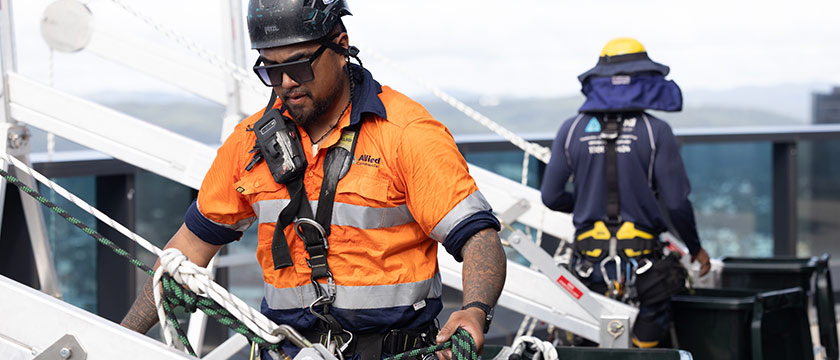
Installation is completed by our ATA Certified technicians, typically within 1-5 days depending on system complexity. Cables are tensioned to specification and guardrails are checked for height and strength. Mechanically fixed metal-roof anchors are inspected and tagged. Independent proof load testing of drilled-in anchors is performed by Anchor Testing Australia. The building owner receives a handover package including as-built layout drawings, user manual, maintenance schedule, inspection records, and manufacturer product data.
Key Benefits
- ATA Certified Installers -- proven competency in anchor system installation
- Designed in-house by qualified engineers with structural calculations
- Certified on completion -- ready to use immediately with no further approvals
- Custom layouts tailored to your building's access requirements
- Integrated with roofing and facade works to reduce mobilisation costs
- Full handover package with as-built drawings, user manual, and certificates
- All components sourced from certified manufacturers with product traceability
System Capabilities
What we deliver
Complete system design by qualified engineers
Anchor points -- roof, parapet, and structural mounting options
Horizontal static lines and rail systems
Vertical lifeline systems for ladder and hatch access
Guardrail perimeter protection systems
Walkway systems for fragile or slippery roof surfaces
Roof access hatches with integrated safety posts
Full certification package with as-built drawings and user manual
Regulatory Compliance
Standards and regulations we certify to
The comprehensive standard suite governing harness systems, anchor devices, horizontal lifelines, and fall-arrest system maintenance. All Allied installations are designed and certified to this standard.
Every anchor point installed must be manufactured to this standard, with independently verified load capacity of 15kN (single user) or 21kN (two users).
Governs the design of walkway systems, guardrails, access ladders, and platform configurations installed as part of the height safety system.
Referenced for structural calculations where anchor points are fixed to steel framing, and for the design of custom guardrail and walkway support structures.
Wind loading on guardrails and walkway systems is calculated per this standard to ensure structural adequacy under extreme weather events.
System Ratings
At a glance
Inspection Process
How we deliver
Site Survey & Brief
Engineers survey the roof structure, identify all access requirements (who needs to go where and why), document fixing opportunities, and assess structural capacity for anchor and guardrail loads.
Engineering Design
CAD layout drawings are prepared showing anchor locations, cable runs, guardrail positions, and walkway routes. Structural calculations confirm fixing adequacy. Fall-distance and clearance calculations verify that every anchor provides safe arrest within the available clearance.
Installation
Accredited technicians install all system components. Each cable is tensioned to specification and each guardrail verified for height and strength. Mechanically fixed metal-roof anchors are inspected and tagged. Independent proof load of drilled-in anchors is performed by Anchor Testing Australia. Weather sealing is applied at every roof penetration.
Certification & Handover
The completed system is formally inspected and certified to AS/NZS 1891 and AS/NZS 5532. The handover package includes as-built drawings, user manual, maintenance schedule, and individual component certificates.
FAQ
Common questions
How long does it take to design and install a height safety system?
The design phase typically takes 1-2 weeks from survey to approved drawings, depending on roof complexity and the number of stakeholders involved in approval. Installation takes 1-5 days for most commercial buildings. A simple system (10-20 anchor points on a standard metal roof) can be installed in a single day. Complex systems with guardrails, walkways, multiple cable runs, and access hatches may take up to 5 days. We coordinate installation timing with building management to minimise disruption, and most work is completed during standard business hours.
What is the difference between an anchor point and a static line?
An anchor point is a single fixed device that a worker connects their harness to via a lanyard. It provides fall protection within a limited radius (typically 2-3 metres) around the anchor location. A static line (also called a horizontal lifeline) is a cable or rail system that runs across the roof, allowing a worker to connect at one end and traverse the full length of the cable without disconnecting. Static lines are used where workers need to move along a roof edge, across a long roof section, or between equipment locations. The choice between anchor points and static lines depends on the work patterns: frequent movement = static line, stationary work positions = anchor points.
Do you provide training for building occupants?
We provide comprehensive user documentation including a site-specific user manual, as-built layout drawings showing anchor and cable locations, and operating instructions for each system component. For building managers and regular roof access personnel, we offer on-site orientation sessions covering system layout, connection procedures, equipment inspection, and emergency procedures. Formal working-at-height training (including harness fitting, anchor selection, and rescue procedures) should be obtained from a registered training organisation (RTO) -- we can recommend qualified providers in each capital city.
Related Work
Projects
Industries
Industry partners
Specialist partners
- Height Safety Australia
City-based install and certification teams
- Anchor Testing Australia
NATA-aligned anchor proof load testing
Need Design & Installation?
Contact us for a no-obligation quote or free site inspection.