Inspections & Tagging
Annual height safety inspections conducted by ATA Certified technicians to AS/NZS 1891 and state WHS regulations. Independent proof load of drilled-in anchors is performed by Anchor Testing Australia.
Overview
Under Australian Work Health and Safety legislation, a Person Conducting a Business or Undertaking (PCBU) has a duty to ensure that any height safety system installed on their building is maintained in a safe, functional condition. This obligation is met through regular inspection and tagging by a competent person. Independent proof load testing of drilled-in anchors is a separate job, performed by Anchor Testing Australia. Failure to keep systems in a safe condition can result in penalties, insurance voiding, and personal liability for directors and officers.
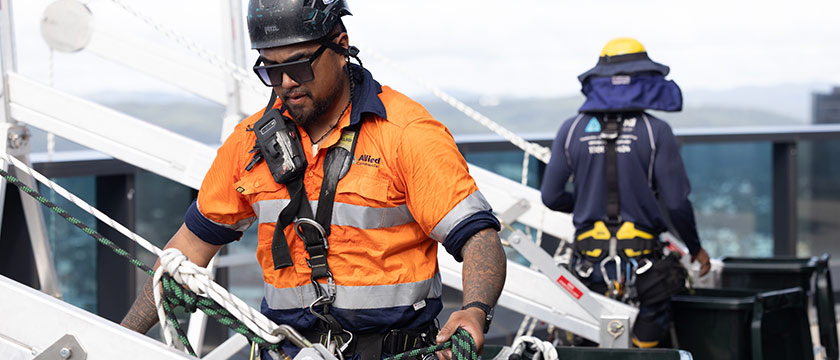
Allied Commercial conducts annual height safety inspections in accordance with AS/NZS 1891.4 (Selection, Use and Maintenance of Personal Fall-Arrest Systems). As an ATA Certified Installer and Tester, our technicians inspect, tag, and document systems. Every anchor point is visually inspected for corrosion, deformation, and fixing integrity. Static lines and horizontal life-lines are checked for cable tension, termination condition, and intermediate anchor spacing. Guardrails are assessed for height, load capacity, and infill panel integrity. Access ladders and hatches are checked against AS 1657 requirements. Independent proof load testing of drilled-in anchors is a separate service delivered by Anchor Testing Australia.
In Queensland, cable-based height safety systems require inspection every 6 months (not 12) under the state WHS Code of Practice. Our scheduling system tracks these differing requirements and ensures your building never lapses in certification. Every inspection generates a digital certificate with GPS-tagged photographs, a defect register, and a recommended action plan.
Non-compliant items are red-tagged and immediately taken out of service with clear signage. We provide a detailed defect report and rectification quote so that the system can be repaired and re-certified with minimum downtime. For portfolio clients, we provide consolidated reporting across all sites with compliance dashboards showing certificate status, upcoming inspection dates, and outstanding defect items.
Key Benefits
- ATA Certified technicians: inspection, tagging, and install competency
- Meet your legal WHS duty-of-care obligations as a PCBU
- Digital certificates with GPS-tagged photos accessible anytime
- Non-compliant items identified and red-tagged immediately
- Portfolio dashboards provide at-a-glance compliance status
- QLD 6-monthly cable inspection requirements automatically tracked
- Brand-agnostic -- we inspect all manufacturers and system types
System Capabilities
What we deliver
Annual inspection and tagging per AS/NZS 1891.4
Six-monthly cable system inspections (QLD requirement)
Visual assessment of anchor points, with independent drilled-in proof load via Anchor Testing Australia
Static line and horizontal life-line inspection
Guardrail height, strength, and infill panel checks
Access ladder and hatch assessment per AS 1657
Digital certificates with GPS-tagged photography
Portfolio-wide compliance dashboards
Regulatory Compliance
Standards and regulations we certify to
The primary standard governing inspection requirements, competency of inspectors, testing procedures, tagging protocols, and documentation for height safety system certification.
Specifies the design, manufacturing, and testing requirements for anchor points. Inspections verify that installed anchors meet the 15kN (single person) or 21kN (two person) load rating requirements.
Governs the design and maintenance requirements for fixed access systems including roof access ladders, hatches, walkways, and platform guardrails.
Each state has specific regulations for work at height. Queensland requires 6-monthly inspection of cable systems. All states require annual inspection of fall-arrest anchor systems.
Specifies requirements for full-body harnesses and their connection to anchor systems, including maximum arrest force (6kN) and fall distance calculations.
System Ratings
At a glance
Inspection Process
How we deliver
Schedule & Access
We coordinate with your building manager to schedule the inspection at a convenient time. Most inspections are completed in a single day. We require safe roof access and a current anchor register if available.
Physical Inspection
Every anchor point, static line, horizontal life-line, guardrail, ladder, and hatch is visually inspected, functionally tested, and assessed against the requirements of AS/NZS 1891 and AS 1657.
Tagging & Red-Flagging
Compliant items receive a green certification tag with the next inspection due date. Non-compliant items are red-tagged, taken out of service, and documented with photography and a defect description.
Certificate & Report
A digital compliance certificate, GPS-tagged photographic record, defect register, and recommended action plan are delivered within 48 hours. Portfolio dashboards are updated in real-time.
FAQ
Common questions
How often do height safety systems need inspection?
Under AS/NZS 1891.4, all fall-arrest anchor systems require formal inspection and recertification at least every 12 months by a competent person. However, in Queensland, cable-based systems (static lines and horizontal life-lines) must be inspected every 6 months under the state WHS Code of Practice. We also recommend that building managers conduct a brief visual check (looking for obvious damage, corrosion, or missing tags) every 6 months between formal inspections. Our scheduling system automatically tracks these differing requirements and sends reminders 30 days before your inspection is due.
What happens if a system fails inspection?
Non-compliant items are immediately red-tagged with a "DO NOT USE" label and taken out of service. The defect is documented with photography, a description of the failure mode, and a risk assessment. We provide a detailed rectification quote within 48 hours, and most rectification works can be completed within 1-2 weeks of approval. Once rectified, the item is re-inspected and re-certified. Until rectification is complete, the building owner must ensure that alternative fall protection measures are in place for any work requiring roof access.
Can you inspect systems installed by other companies?
Yes. We inspect and tag all brands and types of height safety systems regardless of the original installer. We are brand-agnostic and assess every system against the requirements of AS/NZS 1891, AS/NZS 5532, and AS 1657. If we identify design issues (for example anchors positioned too far apart for the intended lanyard length, or systems that do not prevent a user from reaching an unprotected edge), these are documented as design non-compliances separate from maintenance items. Independent proof load testing of drilled-in anchors is booked with Anchor Testing Australia.
ATA Certified
Inspections delivered by ATA Installer, Tester, and Height Safety credentialed technicians.
Industries
Industry partners
Specialist partners
- Height Safety Australia
City-based install and certification teams
- Anchor Testing Australia
NATA-aligned anchor proof load testing
Need Inspections & Tagging?
Contact us for a no-obligation quote or free site inspection.