Upgrades & Rectifications
Solutions to improve the safety and accessibility of your asset, with tailored upgrades aligned to the latest Australian Standards.
Overview
Height safety systems are not "install and forget." Standards evolve, access requirements change (especially when solar panels are installed), and components deteriorate over time. A system that was compliant when installed 10 years ago may no longer meet current requirements -- and a system that is physically intact but poorly designed for the current access needs creates risk even if it passes a standard inspection.
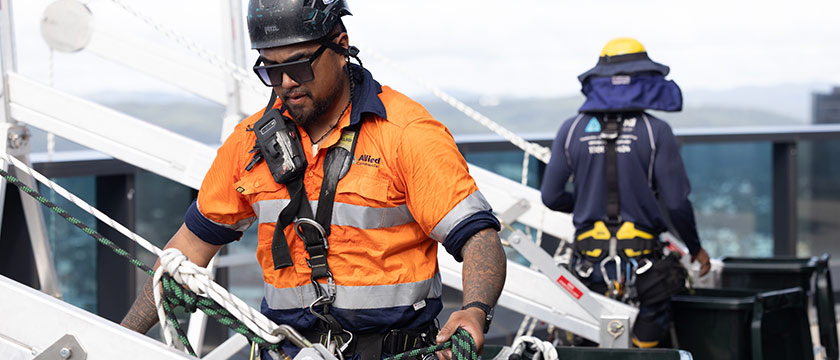
Allied Commercial's upgrade and rectification service addresses both scenarios. Following an inspection that identifies non-compliant items, we provide engineered rectification solutions that restore the system to full compliance. This may involve replacing corroded anchors, re-tensioning static lines, upgrading guardrail infill panels, or re-positioning anchor points to provide coverage for new access paths (such as around solar panel arrays).
For buildings where the existing height safety system is fundamentally inadequate -- anchor points too far apart, insufficient coverage of the roof perimeter, no fall-arrest provision for specific maintenance tasks -- we design a comprehensive upgrade that addresses the gaps. Our engineers prepare layout drawings showing existing and proposed anchor locations, calculate fall distances and clearances, and specify the system components required.
All upgrade works are designed by qualified engineers, installed by accredited technicians, and certified on completion to the current version of AS/NZS 1891. We provide updated user manuals, layout drawings, and certification documentation. Where existing components are retained, they are re-inspected and re-certified as part of the upgrade programme.
Key Benefits
- Bring non-compliant systems up to current AS/NZS 1891 standards
- Retrofit solutions engineered for any roof type without structural modification
- Combined upgrade and recertification completed in a single site visit
- Solar access pathways ensure safe maintenance of rooftop solar arrays
- Updated user manuals and layout drawings provided with every upgrade
- Engineering-led design ensures fall distances and clearances are calculated correctly
System Capabilities
What we deliver
Rectification of non-compliant items identified during inspection
Anchor point replacement -- corrosion, damage, or design upgrade
Static line re-tensioning, cable replacement, and termination repair
Guardrail upgrade -- height, infill, and load capacity improvements
Solar panel access pathway design and installation
Fall-distance and clearance calculations for edge-adjacent anchors
Updated user manuals, layout drawings, and certification
Combined upgrade + recertification in a single site visit
Regulatory Compliance
Standards and regulations we certify to
Defines what constitutes a non-compliant item requiring rectification, and the re-certification process following upgrade works.
All replacement or new anchor points must be manufactured and installed to this standard, with 15kN or 21kN load capacity depending on the intended number of users.
Guardrail upgrades must comply with this standard for top rail height (minimum 900mm), infill requirements, and load capacity (minimum 0.60kN/m distributed horizontal load).
System Ratings
At a glance
Inspection Process
How we deliver
Defect Assessment
Non-compliant items from the inspection report are reviewed, and a rectification scope is prepared with engineering input where design changes are required.
Engineering Design
For system upgrades, engineers prepare layout drawings, fall-distance calculations, fixing specifications, and a material schedule. Designs account for roof structure, edge distances, and intended use cases.
Installation
Accredited technicians install replacement anchors, re-tension cables, upgrade guardrails, and install new pathway systems. Mechanically fixed metal-roof anchors are inspected and tagged. Independent proof load of drilled-in anchors is performed by Anchor Testing Australia.
Re-Certification
The upgraded system is formally inspected, all components are tagged with new certification dates, and updated user manuals and layout drawings are issued.
FAQ
Common questions
Do I need to upgrade if my systems passed inspection?
Not necessarily. However, there are circumstances where upgrades are recommended even when systems pass their annual inspection. If Australian Standards have been revised since installation and the current system does not meet the new requirements, an upgrade brings the system up to date. If access needs have changed -- for example, solar panels have been installed and maintenance workers now need to traverse areas of the roof not covered by the original height safety system -- additional anchor points or pathways should be installed. If the system is approaching the end of its expected service life (typically 15-25 years for stainless steel systems), proactive replacement avoids the risk of in-service failure.
Can height safety be added to existing roofs without structural modification?
In most cases, yes. Our engineers design fixing methods appropriate to each roof type. For metal deck roofs, we use clamp-to-structure systems that grip the purlin without penetrating the roof sheeting. For concrete roofs, chemical anchors provide high load capacity without the vibration damage of mechanical drilling. For lightweight roofs where purlin capacity is limited, we distribute anchor loads across multiple fixing points using spreader plates. In all cases, the fixing method is engineered to the specific roof structure, and weatherproofing is maintained at every penetration or attachment point.
How long does a typical height safety upgrade take?
Rectification of a small number of tagged items (one to three anchors or a single static line section) is often completed in one day. Larger upgrades covering multiple roof zones, new solar access pathways, or full perimeter guardrail replacement typically run two to five days depending on roof area, weather, and access constraints. We schedule upgrade and recertification in the same visit where possible so the building returns to full compliance without a second mobilisation.
Do upgraded systems need re-certification immediately?
Yes. Any component replaced, repositioned, or newly installed must be inspected and tagged before use. Drilled-in anchors are independently proof-loaded by Anchor Testing Australia. Allied issues an updated digital inspection record, defect closure report, and revised layout drawings within 48 hours of completion.
Industries
Industry partners
Specialist partners
- Height Safety Australia
City-based install and certification teams
- Anchor Testing Australia
NATA-aligned anchor proof load testing
Need Upgrades & Rectifications?
Contact us for a no-obligation quote or free site inspection.