Remediation Projects
Allied Commercial excels in Construction Remediation Projects, offering specialised expertise and innovative solutions tailored to restore and enhance built environments.
Overview
Structural remediation is the process of restoring a deteriorated or damaged structure to a condition that meets its original design intent, or adapting it to meet current Australian Standards. Allied Commercial brings together investigative capability, engineering design, and hands-on construction expertise to deliver remediation outcomes that extend building life by decades rather than years.
Our approach begins with non-destructive testing (NDT) and material sampling to understand the root cause of deterioration -- whether that is chloride-induced reinforcement corrosion, carbonation, alkali-silica reaction, or mechanical damage. This evidence base informs the engineering repair specification, ensuring that every dollar spent addresses actual condition rather than conservative assumption.
We work to AS 3600:2018 for concrete structures and reference EN 1504 (Products and Systems for the Protection and Repair of Concrete Structures) for material selection and application methodology. All remediation designs are prepared or reviewed by registered structural engineers and certified on completion with full as-built documentation.
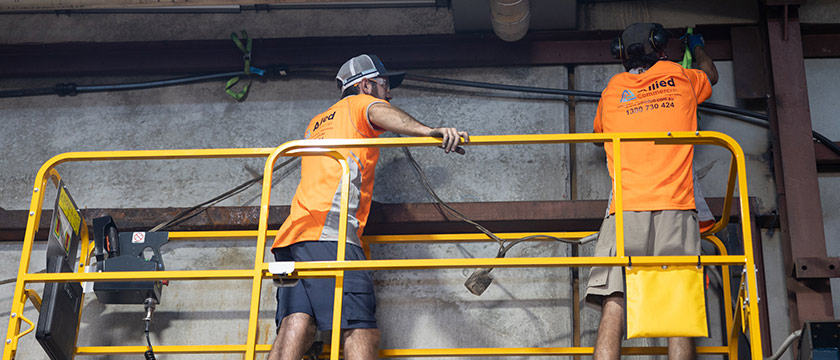
From minor spalling repairs on a single facade element to full structural strengthening programmes across multi-storey buildings, Allied delivers remediation works in occupied commercial environments with minimal disruption to tenants, building operations, and public interfaces.
Key Benefits
- Extend building lifespan by 25-50 years with targeted intervention
- Prevent escalating repair costs through early-stage treatment
- Maintain tenant satisfaction with staged, low-disruption works
- Full engineering sign-off by registered structural engineers
- Durability modelling predicts future condition for capital planning
- Comprehensive photographic and test documentation for audit
Engineering Capabilities
What we deliver
Concrete spalling and delamination repair to AS 3600
Reinforcement corrosion treatment and cathodic protection
Structural strengthening with carbon fibre and steel plate bonding
Crack injection -- epoxy and polyurethane systems
Protective coatings and anti-carbonation systems per EN 1504
LiDAR scanning for 3D structural mapping and defect documentation
Facade monitoring sensor installation for long-term movement tracking
Post-tensioning remediation and tendon replacement
Engineering Standards
Australian Standards compliance
Primary design and construction standard for all reinforced concrete remediation works. Governs material properties, durability requirements, and structural adequacy of repairs.
Internationally recognised standard for repair product selection, surface preparation, and application methodology. Parts 1-10 cover principles, quality control, and structural bonding.
Applies to structural steel strengthening, connection design, and steel plate bonding used in remediation of steel-framed or composite structures.
Australian handbook providing practical guidance on diagnosis, repair specification, and quality control for concrete remediation projects.
Allied operates under a quality management system ensuring consistent documentation, traceability, and audit-ready records for all remediation works.
Technical Specifications
At a glance
Engineering Methodology
How we deliver
Investigation & Testing
Non-destructive testing, core sampling, chloride profiling, carbonation depth measurement, and LiDAR scanning to map the full extent of defects before any work begins. Results are analysed by our engineering team to determine root cause and severity.
Engineering Design
Registered structural engineers prepare repair specifications referencing AS 3600 and EN 1504, including material schedules, method statements, hold points, and quality assurance requirements tailored to your building.
Remediation Execution
Licensed crews execute the repair scope -- concrete removal to sound substrate, reinforcement treatment, patch repair with Class R3/R4 mortars, crack injection, waterproofing membranes, and protective coating application.
Certification & Handover
Engineering completion certificates, as-built documentation, photographic records, material test certificates, and a 10-year maintenance plan are delivered at project close.
FAQ
Common questions
How long does a typical remediation project take?
Timelines depend on the extent of deterioration and access constraints. Minor facade spalling repairs on a single elevation may take 2-4 weeks. Large structural remediation projects involving multiple floors, reinforcement replacement, and protective coating systems can span 3-6 months. We provide a detailed programme at quoting stage with critical path milestones, and we sequence works to minimise disruption -- often working floor-by-floor or elevation-by-elevation in occupied buildings.
Can remediation work be done while the building is occupied?
Yes. The majority of our remediation projects are carried out on occupied commercial and residential buildings. We plan works to minimise noise (jackhammering scheduled outside business hours), control dust with extraction and containment systems, maintain safe pedestrian access at all times, and coordinate with building management for tenant notifications. Our project managers are experienced in stakeholder communication and will provide weekly progress updates to all parties.
What is the difference between repair and remediation?
Repair typically refers to fixing a single defect -- patching a spalled area, sealing a crack. Remediation is a broader programme that addresses the underlying cause of deterioration across the entire structure. For example, if chloride-induced corrosion is causing spalling on one column, a repair fixes that column. A remediation programme investigates the full extent of chloride contamination, predicts future deterioration using durability modelling, and designs a phased intervention strategy that treats the worst areas first while monitoring the rest.
Do you provide engineering certification on completion?
Absolutely. All remediation works are designed by engineers registered under the relevant state scheme (RPEQ in Queensland, RPE in NSW, RPEng in Victoria). On completion, the designing engineer inspects the works and issues a completion certificate confirming the repairs meet the specification and relevant Australian Standards. This certificate is typically required by building owners for insurance, body corporate records, and compliance with local authority notices.
Industries
Need Remediation Projects?
Contact us for a no-obligation quote or free site inspection.